|
|
By
Wikipedia,
the free encyclopedia,
http://en.wikipedia.org/wiki/Orbital_node 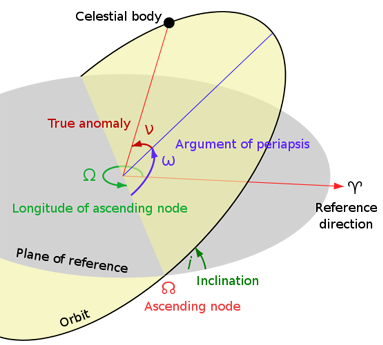 | |
The ascending node. |
An orbital node is one of the two points where an orbit crosses a plane of reference which it is inclined to. An orbit which is contained in the plane of reference (called non-inclined) has no nodes. Common planes of reference include:
The line of nodes is the intersection of the object's orbital plane with the plane of reference. It passes through the two nodes.
If a reference direction from one side of the plane of reference to the other is defined, the two nodes can be distinguished. For geocentric and heliocentric orbits, the ascending node (or north node) is where the orbiting object moves north through the plane of reference, and the descending node (or south node) is where it moves south through the plane. In the case of objects outside the Solar System, the ascending node is the node where the orbiting secondary passes away from the observer, and the descending node is the node where it moves towards the observer.
The symbol of the ascending node is  (Unicode: U+260A, ☊), and the symbol of the descending node is (Unicode: U+260A, ☊), and the symbol of the descending node is  (Unicode: U+260B, ☋). In medieval and early modern times the ascending and descending nodes were called the dragon's head (Latin: caput draconis, Arabic: ra's al-jauzahar) and dragon's tail (Latin: cauda draconis), respectively. Also, corruptions of the Arabic term such as ganzaar, genzahar, geuzaar and zeuzahar were used in the medieval West to denote either of the nodes. The Greek terms αναβιβάζων and καταβιβάζων were also used for the ascending and descending nodes, giving rise to the English words anabibazon and catabibazon. (Unicode: U+260B, ☋). In medieval and early modern times the ascending and descending nodes were called the dragon's head (Latin: caput draconis, Arabic: ra's al-jauzahar) and dragon's tail (Latin: cauda draconis), respectively. Also, corruptions of the Arabic term such as ganzaar, genzahar, geuzaar and zeuzahar were used in the medieval West to denote either of the nodes. The Greek terms αναβιβάζων and καταβιβάζων were also used for the ascending and descending nodes, giving rise to the English words anabibazon and catabibazon.
The position of the node may be used as one of a set of parameters, called orbital elements, which describe the orbit. This is done by specifying the longitude of the ascending node (or, sometimes, the longitude of the node.)
Lunar nodesFor the orbit of the Moon around the Earth, the reference plane is taken to be the ecliptic, not the equatorial plane. The gravitational pull of the Sun upon the Moon causes its nodes, called the lunar nodes, to precess gradually westward, performing a complete circle in approximately 18.6 years.
See also
Text from Wikipedia is available under the Creative Commons Attribution/Share-Alike License; additional terms may apply.
Published in July 2009.
Click here to read more articles related to aviation and space!
|
|