
 |
|
Philadelphia Intl Airport |
- "Philadelphia Airport" redirects here. For other airports serving Philadelphia, see List of airports in the Philadelphia area. For the airport in Mississippi, see Philadelphia Municipal Airport.
| Philadelphia International Airport |
 |
 |
| IATA: PHL – ICAO: KPHL – FAA LID: PHL
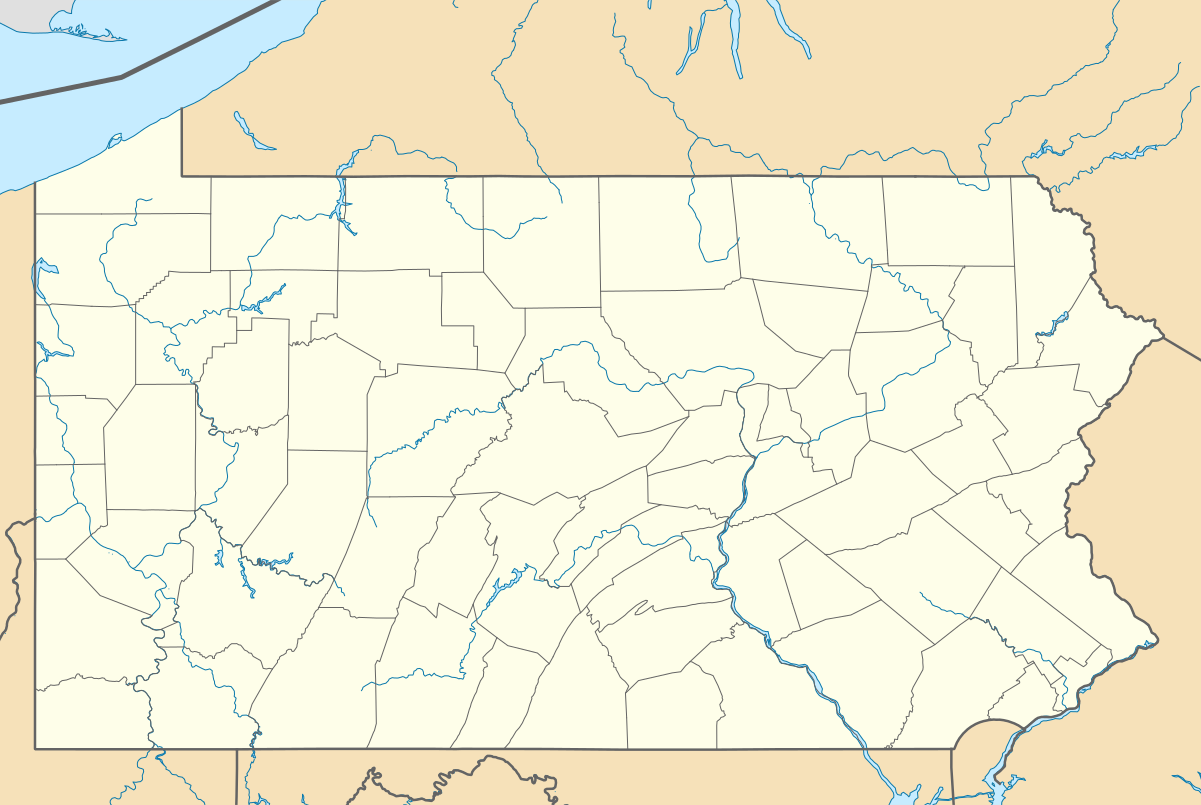
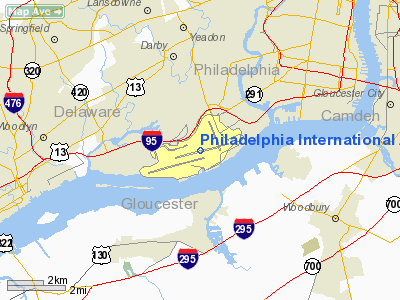
Location of the Philadelphia International Airport
|
| Summary |
| Airport type |
Public |
| Owner |
City of Philadelphia |
| Serves |
Delaware Valley |
| Location |
Philadelphia / Tinicum Township, Pennsylvania, USA |
| Hub for |
|
| Elevation AMSL |
36 ft / 11 m |
| Coordinates |
39°52′19″N 075°14′28″W / 39.87194°N 75.24111°W / 39.87194; -75.24111Coordinates: 39°52′19″N 075°14′28″W / 39.87194°N 75.24111°W / 39.87194; -75.24111 |
| Website |
http://www.phl.org/index.html |
| Runways |
| Direction |
Length |
Surface |
| ft |
m |
| 8/26 |
5,000 |
1,524 |
Asphalt |
| 9L/27R |
9,500 |
2,896 |
Asphalt |
| 9R/27L |
10,506 |
3,202 |
Asphalt |
| 17/35 |
6,500 |
1,664 |
Asphalt |
| Statistics (2007) |
| Aircraft operations |
499,653 |
| Source: Airports Council International
|
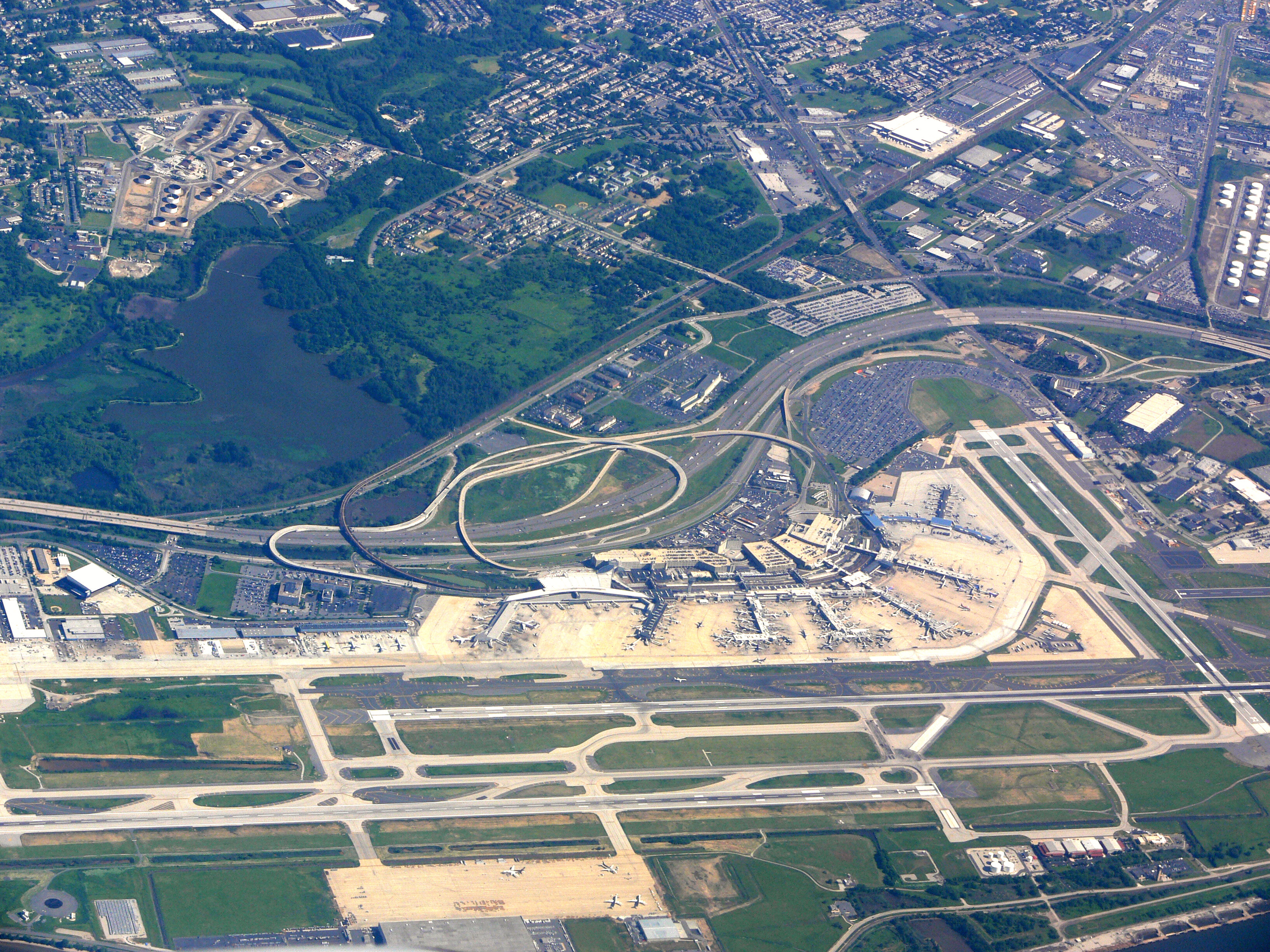
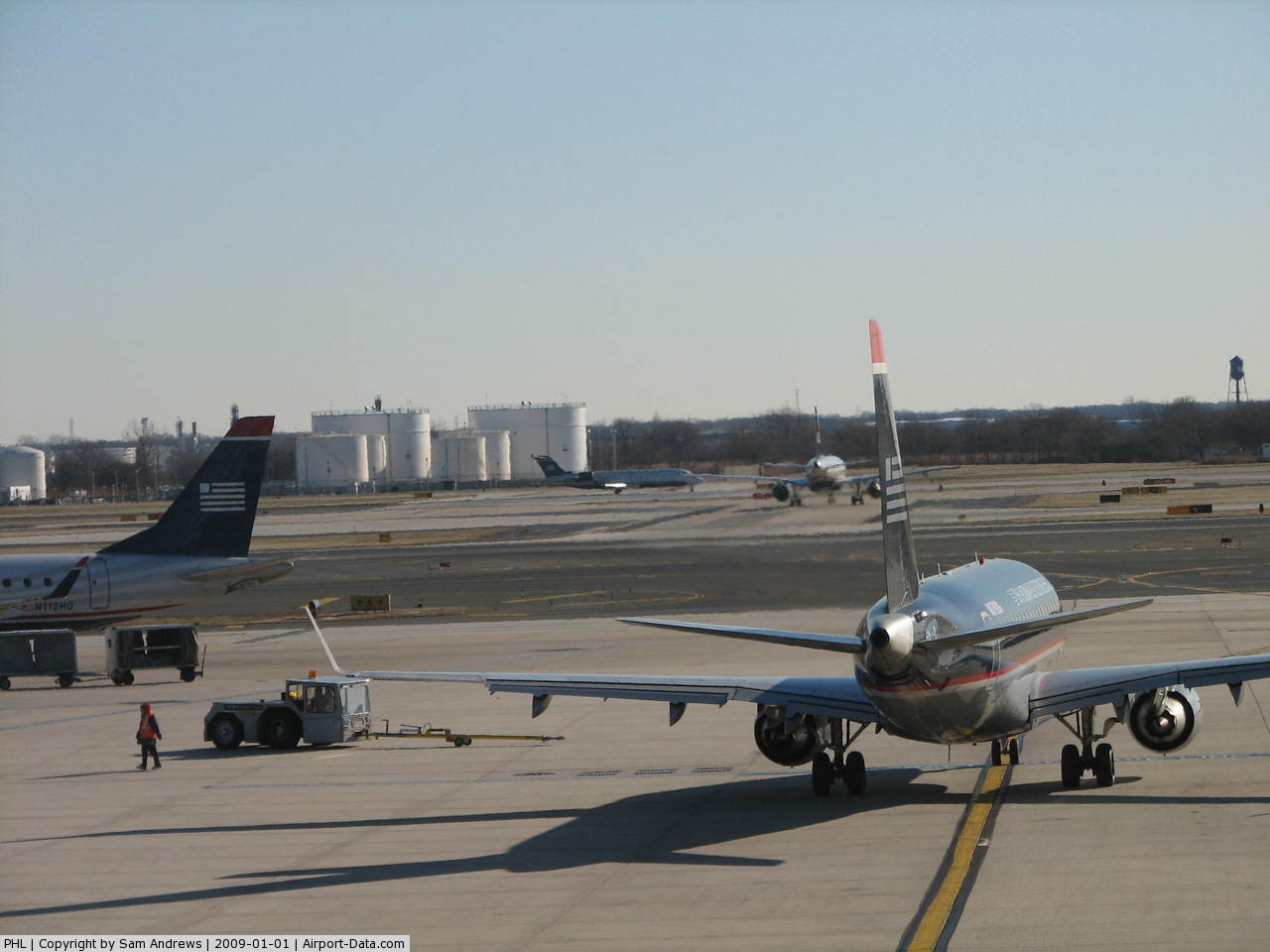
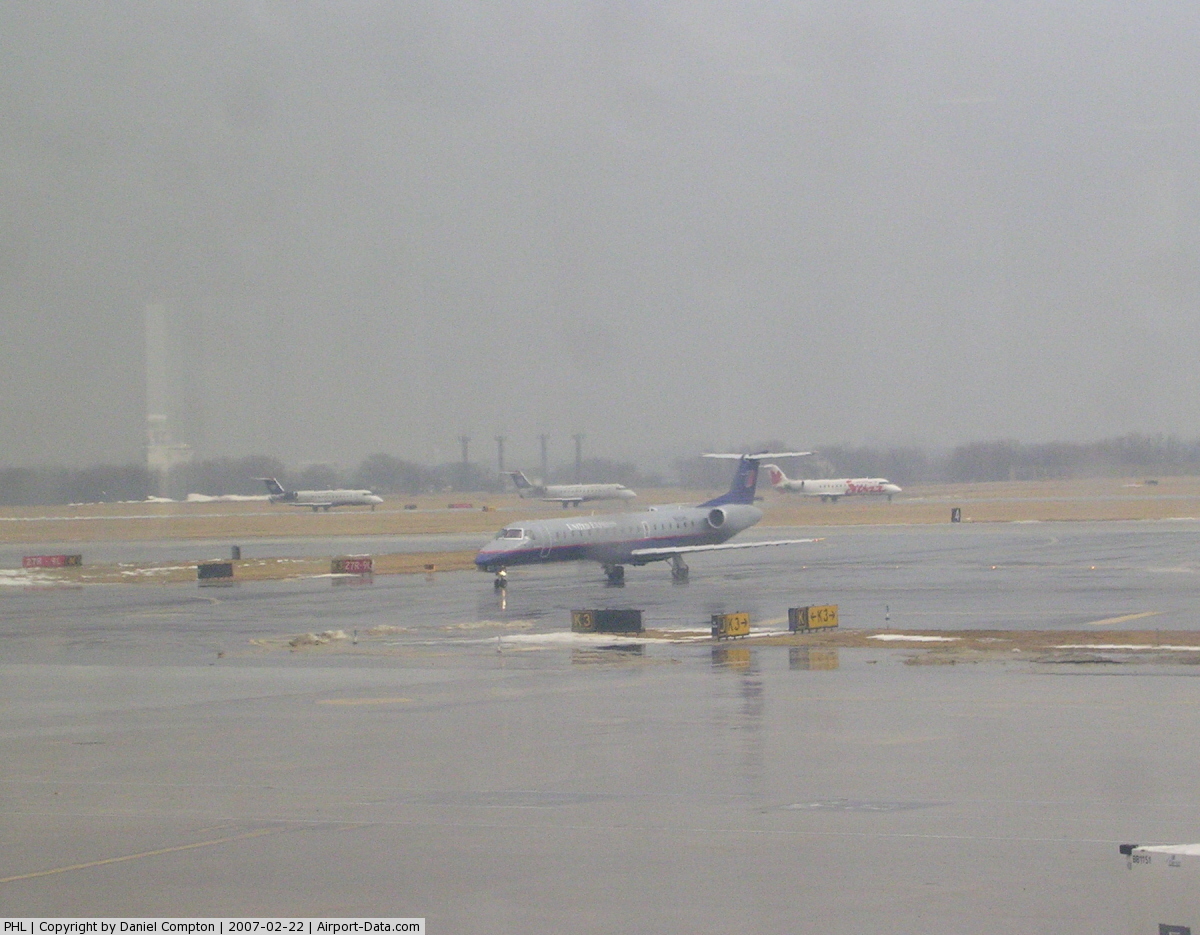
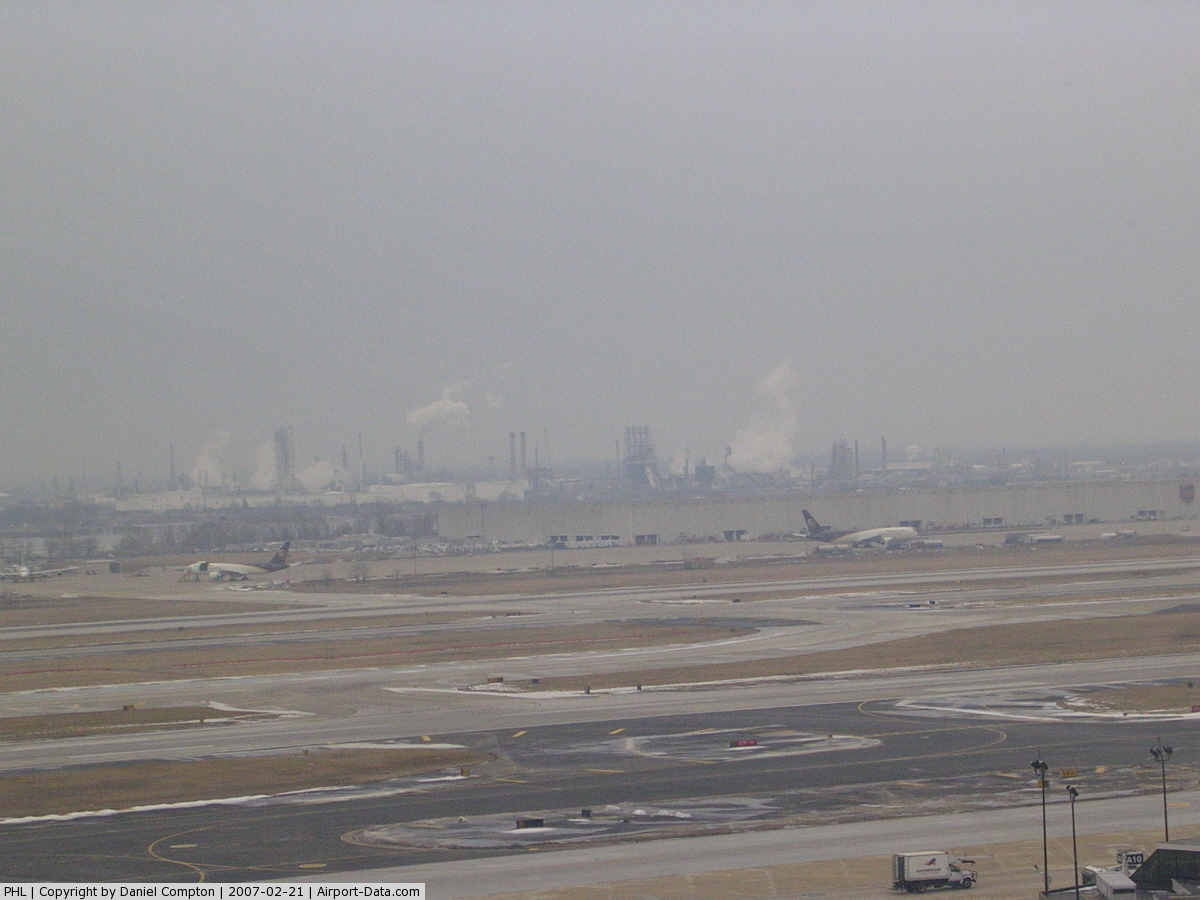
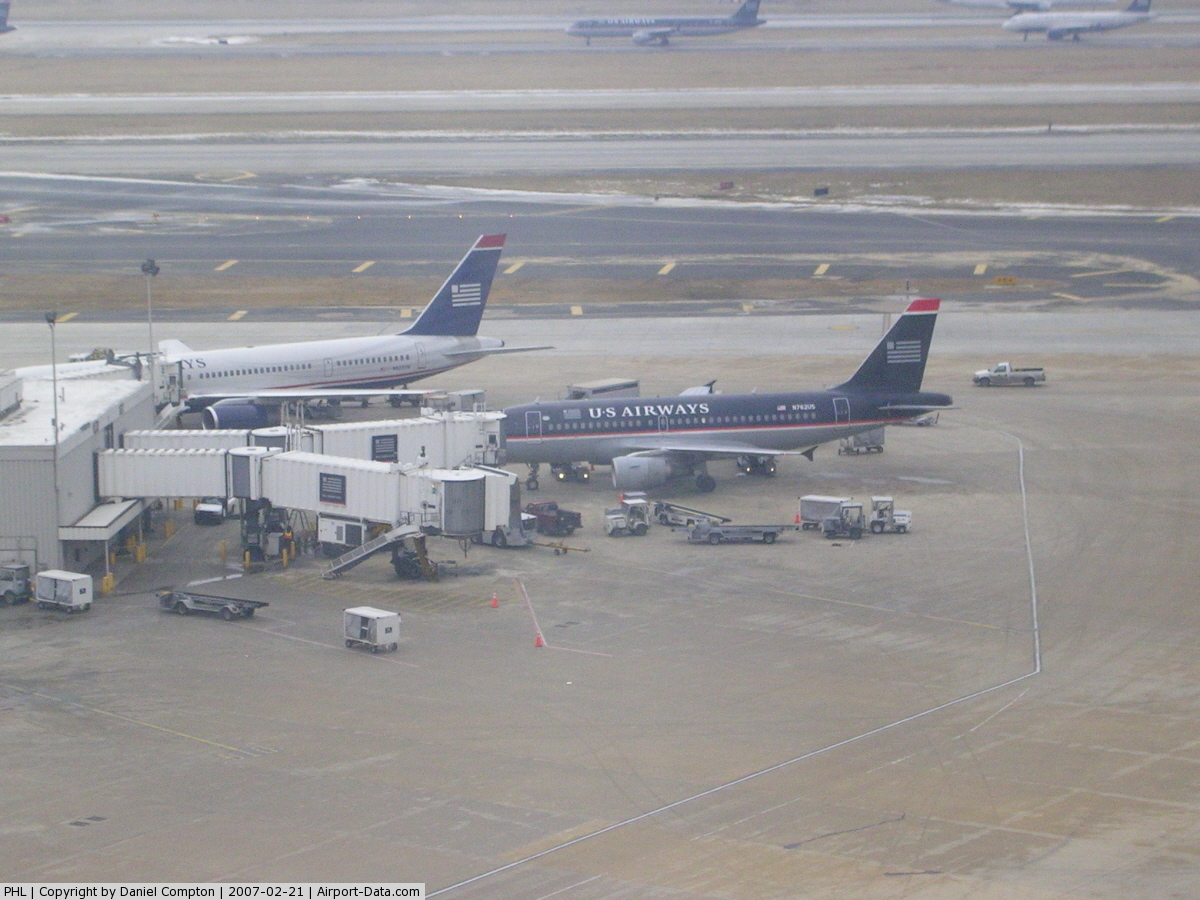
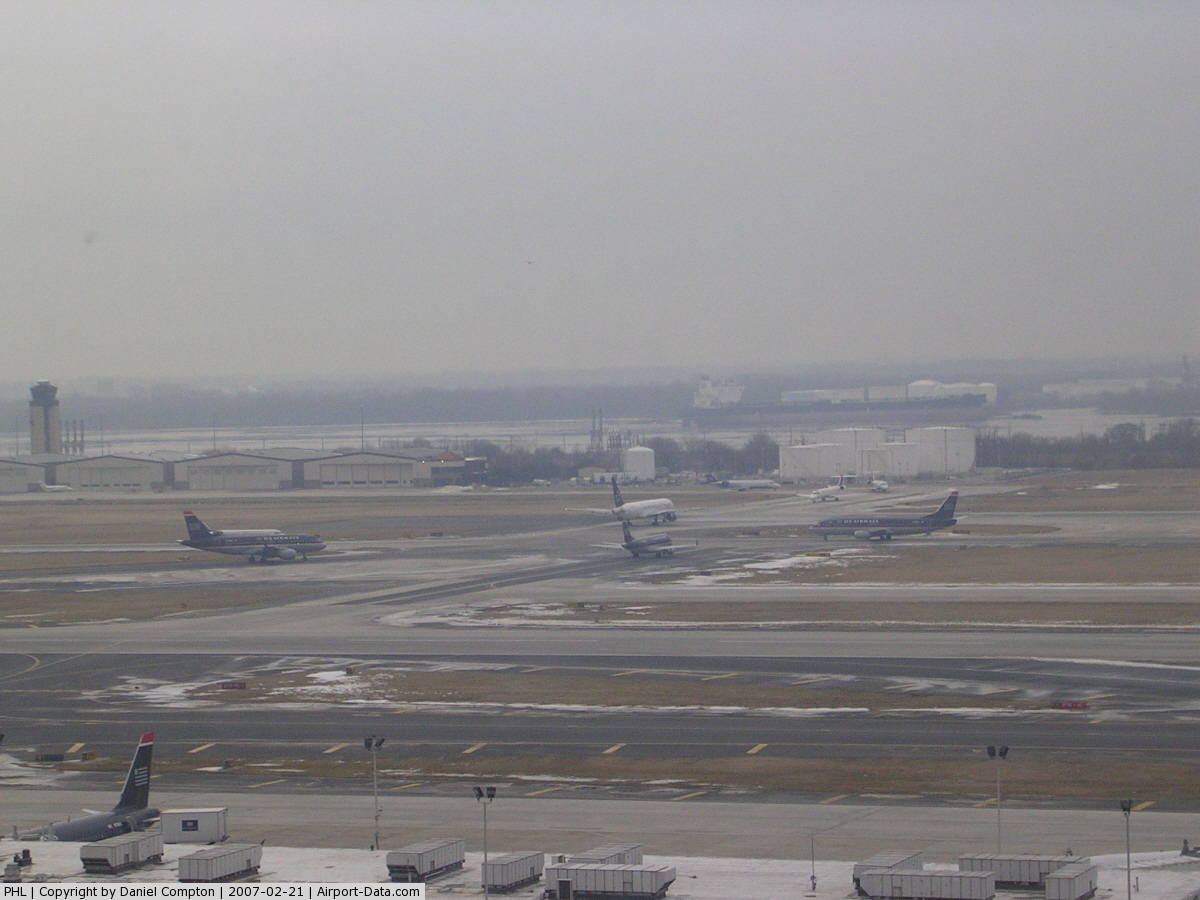
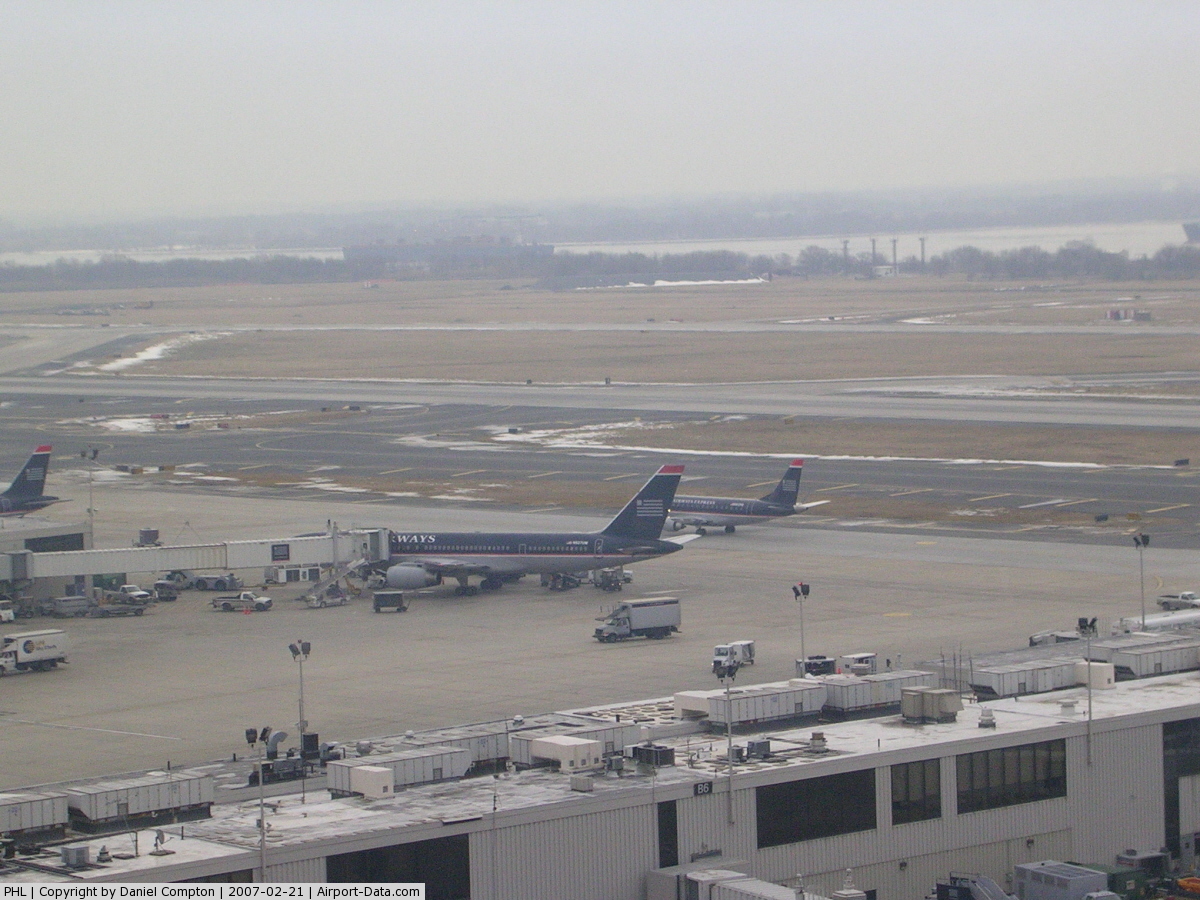
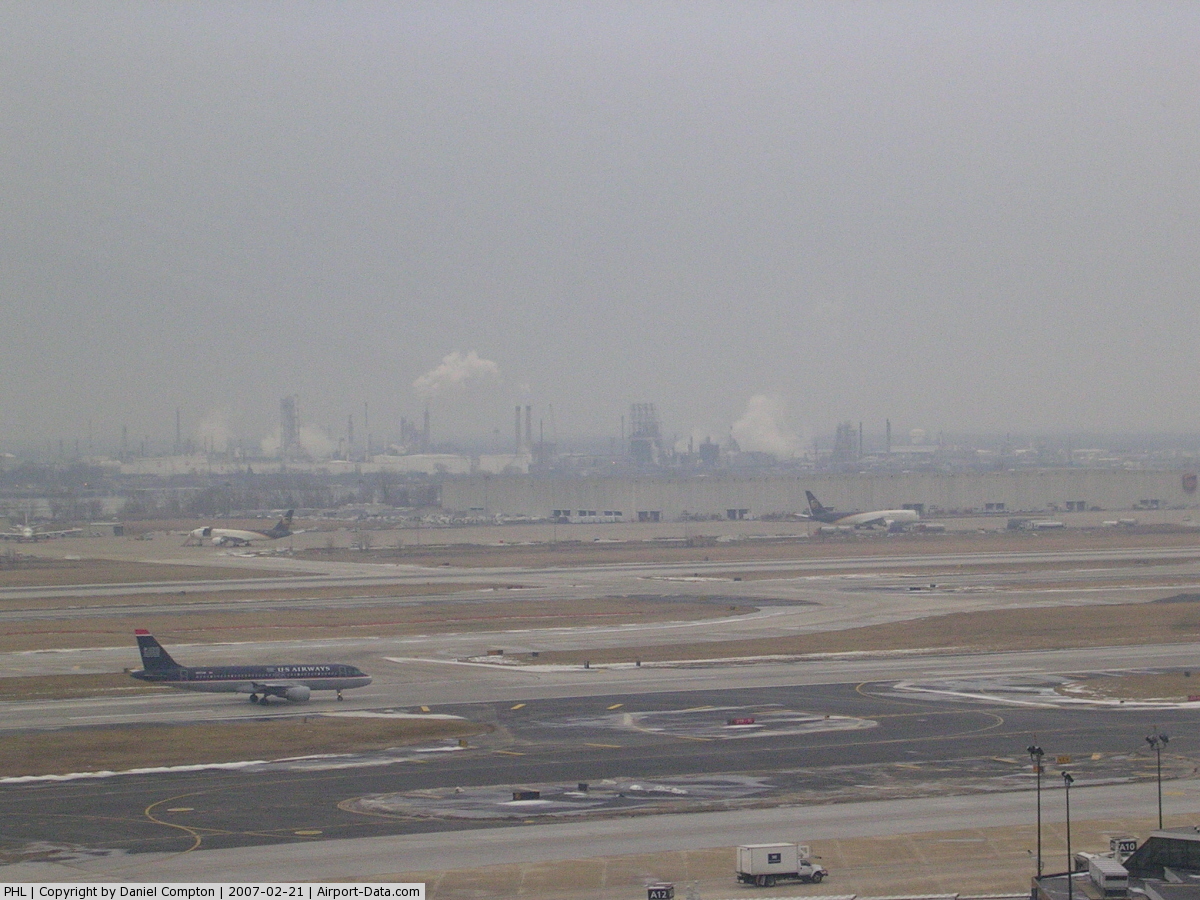
Philadelphia International Airport (IATA: PHL, ICAO: KPHL, FAA LID: PHL) is an airport in Philadelphia, Pennsylvania, and is the largest airport in the Delaware Valley region and in Pennsylvania. As of 2008 it is the 11th busiest airport in the world in terms of aircraft activity. The airport is the primary international hub of US Airways and has service to destinations in the United States, Canada, the Caribbean, Latin America, Europe, and the Middle East. Most of the airport property is located in Philadelphia proper. The international terminal and the western end of the airfield are located in Tinicum Township, Delaware County. History
Starting in 1925, the Pennsylvania National Guard used the PHL site (historically known as Hog Island) as a training field for its airplane pilots. The site was dedicated as the "Philadelphia Municipal Airport" by Charles Lindbergh in 1927. However, there was no proper terminal building until 1940, so airlines used an airfield in nearby Camden, New Jersey. Once the terminal was completed, four airlines (American, Eastern, TWA, and United) started flights to the airport. The oldest parts of the current terminal complex (B and C) were built in the late 50's.
 | |
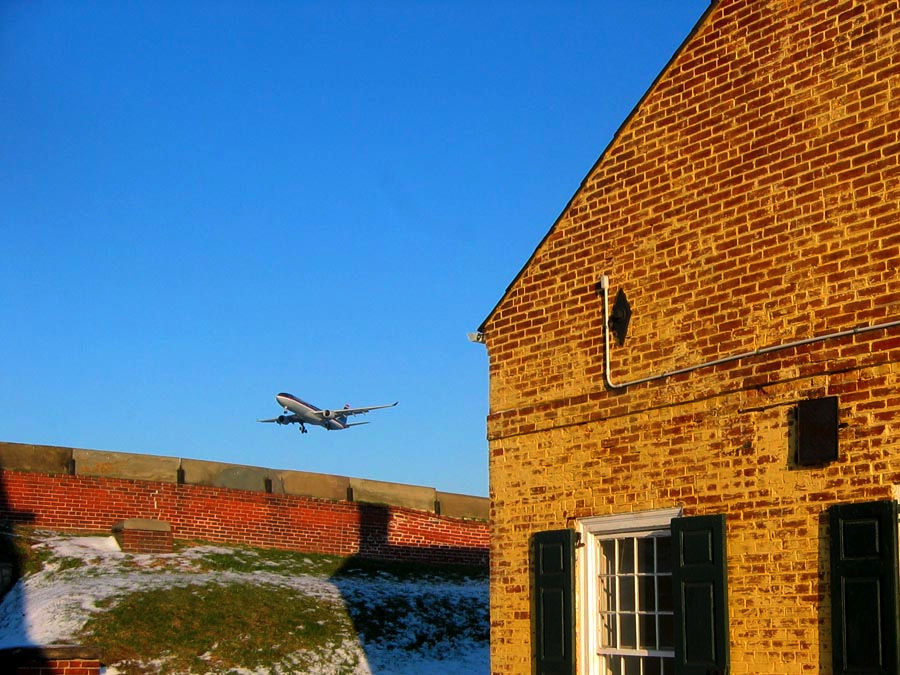
US Airways Airbus A330 landing at PHL, as seen from Fort Mifflin |
World War II use
During World War II the United States Army Air Forces used the airport as a First Air Force training airfield.
Beginning in 1940, the Coatesville-based Rising Sun School of Aeronautics performed primary flight training at the airport under contract to the Air Corps, and after the Pearl Harbor Attack, the I Fighter Command Philadelphia Fighter Wing provided air defense of the Delaware Valley area from the airport. Throughout the war, various fighter and bomber groups were organized and trained at Philadelphia airport and assigned to the Philadelphia Fighter Wing before being sent to advanced training airfields, or being deployed overseas. Known units assigned were the 33d, 327th, 58th, 355th and 358th Fighter Groups.
In June 1943, I Fighter Command transferred jurisdiction of the airport to the Air Technical Service Command (ATSC). ATSC established a sub-depot of the Middletown Air Depot at the airport. The 855th Army Air Forces Specialized Depot unit repaired and overhauled aircraft and returned them to active service. In addition, the Army Air Forces Training Command established the Philco Training School, on January 1, 1943 which trained personnel in radio repair and operations.
Throughout 1945, the Air Force started winding down its use of the airport, with it being returned to full civil control in September.
Modern use
 | |
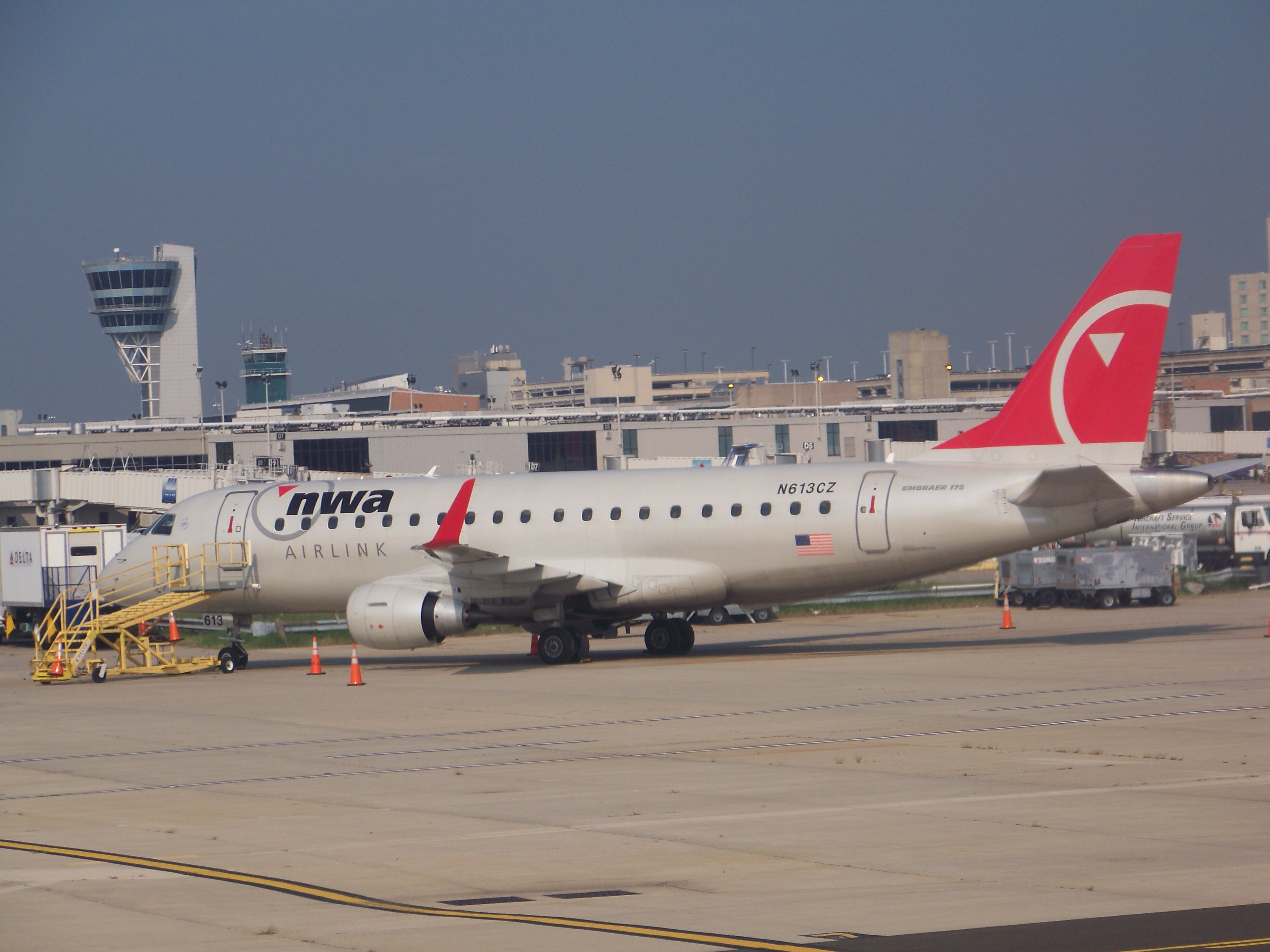
Compass Airlines E175 parked in the east apron with the ground control tower and terminal D in the background. |
Philadelphia Municipal became Philadelphia International in 1945, when American Overseas Airlines began flights to Europe.
In the 1980s, PHL hosted several hub operations. From about airline Deregulation in 1978 until 1982, a small regional carrier called Altair Airlines ran a small hub at PHL using Fokker F-28 jet aircraft. Altair ran flights to regional points such as Rochester and Hartford, and to Florida. Altair shut down in 1982. In the mid-1980s, Eastern Air Lines opened a hub in Concourse C. The airline declined in the late 1980s and sold aircraft and gate leases to Chicago-based Midway Airlines (1976-1991). Midway ran its Philadelphia hub until it shut down in 1991—the same year Eastern shut down. During the 1980s, US Airways (then called USAir) developed a hub at PHL.
US Airways became the dominant carrier at PHL through the 1980s and 1990s and shifted the majority of its hub operations from Pittsburgh to Philadelphia in 2003. In 2004, Southwest Airlines announced it would begin flights from PHL, challenging US Airways in some of its important East Coast and Mid-West markets and is the airline's largest competitor at the airport.
Today, Philadelphia International Airport is one of the busiest airports in the world and among the fastest growing in the United States. Its status as a US Airways hub and the growth of Southwest Airlines and other low-cost carriers have helped passenger traffic to reach record levels. In 2004, a total of 28,507,420 passengers flew through Philadelphia, up 15.5% over 2003.[1] In 2005, 31,502,855 passengers flew through PHL, marking a 10% increase since 2004. [2] In 2006, 31,768,272 passengers flew through PHL, a 0.9% increase. [3]
Such growth has not come without difficulties. There are questions as to how much more passenger growth can occur. PHL's present terminal and runway configuration are reaching full utilization alongside the fact that PHL remains the world's largest airport without an inground fueling system (thus requiring fuel to be trucked to each airplane), have led to congestion and flight delays. Additionally, the airport's parking facilities have been severely taxed. Complete exhaustion of all parking at the airport has become a regular occurrence.[4] However, airport officials have ambitious plans for terminal and runway expansion to resolve these issues.
PHL's fastest growing airline, Southwest, has been working with the City and the airport to expand and improve its facilities. Southwest recently completed construction of a joint ticket counter lobby for the D and E terminals, one large security check point for the two terminals, and additional concessions. A hammerhead expansion to the E concourse was finished in February 2010. [5]
Air traffic and rankings
With 499,653 total flight movements in 2008, Philadelphia International Airport ranks 11th in world in terms of aircraft movement. As recently as 2006, the airport ranked 9th in terms of aircraft movement, but was passed in 2007 by Charles de Gaulle International Airport and by Charlotte/Douglas International Airport. It does not rank in the top 30 rankings for either passenger or cargo movement. In 2008 the airport handled a total of 31.8 million passengers, which for passenger movement would rank it several places behind Charlotte (#30), which handled 33.1 million passengers in 2008. The world's busiest airport in terms of passenger movement in 2008 was Atlanta's Hartfield International Airport with 90,039,280 passengers, nearly three times the passengers that passed through Philadelphia International Airport the same year. Statistics on passenger origination and termination (with PHL airport as an originating or final destination) are not widely available.
Economic impact
Philadelphia International Airport is important to Philadelphia, its metropolitan region and the Commonwealth of Pennsylvania. The Commonwealth's Aviation Bureau reported in its Pennsylvania Air Service Monitor that the total economic impact made by the state's airports in 2004 was $22 billion. PHL alone accounted for $14 billion or 63% of total. The calculations include both direct spending and the multiplier effect of that spending throughout the state's economy.[6]
Runway expansion
 | |
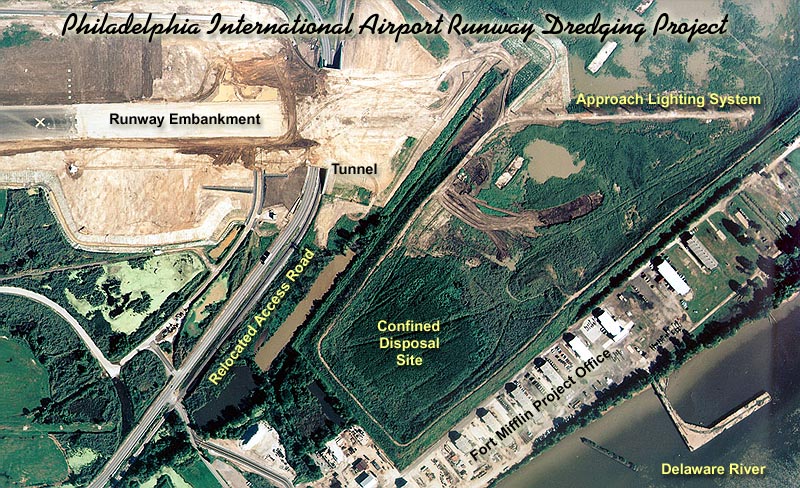
Aerial view of construction of runway 8/26 |
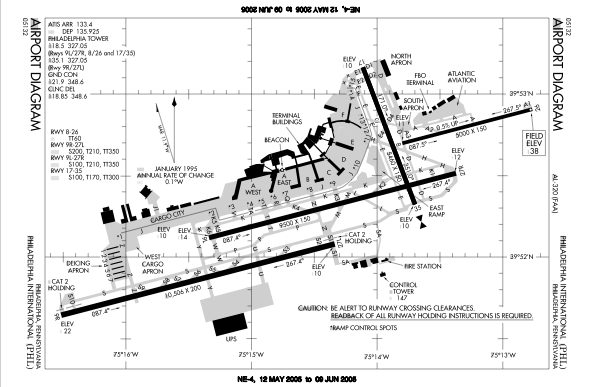
As of 2005, there are two studies which deal with expanding runway capacity at PHL airport. The first is the Runway 17-35 Extension Project EIS [7] which has completed the Final Environmental Impact Statement and ground has recently been broken. The plan is to extend runway 17-35 to length of 6,500 feet, extending it at both ends and incorporating the proper runway safety areas. The second study, the PHL Capacity Enhancement Program [8] has a much larger scope and is considering more drastic ways to increase runway capacity at PHL. Manchester Airport's expansion plans for a second parallel runway involved working closely with PHL air traffic controllers to implement a training program due to similarities in runway configuration in which aircraft must taxi over an active runway. Projected completion March 2009 In an effort to alleviate existing and forecast delays, the City of Philadelphia will complete major improvements to increase airfield capacity at PHL. The Runway 17-35 Extension Project will provide a short-term delay reduction. The major components of the entire project include:
- Extension of Runway 17-35;
- Extension of parallel Taxiways D and E;
- Construction of a High Speed Taxiway for Runway 35 landings exiting to Taxiway E;
- Construction of an Aircraft Holding Apron at Runway 35 end;
- Relocation of Airside Perimeter Service Roads at Runway 17 and Runway 35 ends;
- Installation of High Intensity Runway Lighting (HIRL) and Medium Intensity Taxiway Lighting (MITL);
- Modifications to airfield signs;
- Substantial relocation/modification of navigational aids (NAVAIDS):
- Demolition of existing Taxiways D2 and E2;
- Modifications to existing Economy Parking Lot;
- Re-designation of existing State Route (SR) 291 north of Airport;
- Modifications to Bartram Avenue from the SR 291 intersection to Island Ave., SR 291 and I-95 ramps;
- Demolition of SR 291 at Runway 17 extension work area;
- Construction of Landside Service Road adjacent to I-95 right-of-way limit;
- Associated drainage, grading and utility relocations/modifications.
The first phase (IG), which allowed for the redesignation of Route 291, is complete. The remaining phases I, II and III are in progress.
Ground transportation
Taxis charge a flat rate of $28.50 from the airport to downtown Philadelphia. Travelers should confirm this rate with the driver before taking a taxi.
SEPTA operates regional rail service between the airport and Center City Philadelphia via the Airport Line with convenient stops at University City, Amtrak’s 30th Street, Suburban, and Market East Stations. The fare is $7 if purchased on board, or $6 if purchased at a station in center city. An unlimited ride day pass may be purchased either at a station or on board for $10 for all SEPTA services except to stations in New Jersey. SEPTA also operates various bus routes to the Airport: Route 37 (South Philadelphia to Eastwick and Chester Transportation Ctr via Philadelphia International Airport), Route 108 (69th Street Terminal to Philadelphia International Airport or UPS), and Route 115 (Ardmore/Darby Transportation Center to Philadelphia International Airport). These are $2 or 1 token ($1.55; available at major El and Subway stops), with a transfer for $1.00; exact change is required.
Rental cars are available through a number of companies, all of which must be reached by shuttle bus.
As a benefit to students, local schools including The University of Pennsylvania, Villanova University, Swarthmore College, Haverford College and Saint Joseph's University have provided transportation to the Airport by means of shuttles during such times as Spring Break and Thanksgiving.
Current airport improvement activity
 | |
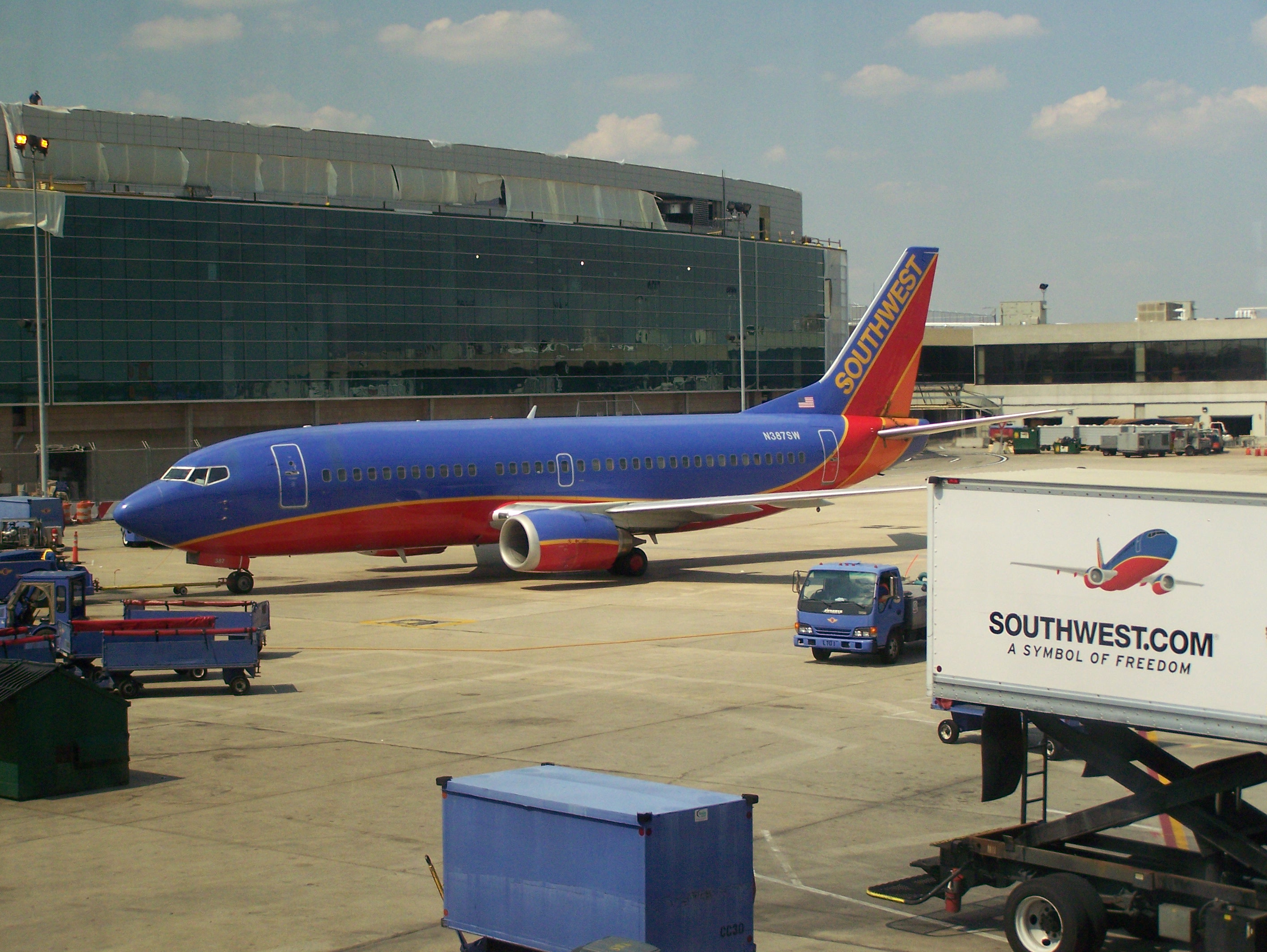
Terminal D&E connector under construction Southwest Airlines Boeing 737 in the foreground |
Current development at the airport includes a new multi-level connector building between Terminals D and E, a 50,000 SF addition to the Terminal E concourse, a 9,000 SF connector building between Bag Claims D and E, and various renovations to areas within the two terminals and the adjacent Thermal Plant.
Phases IA and IB are the new multi-level connector building between Terminals D and E. The first level will house a new baggage make-up area, which will replace the existing areas in each of the terminals. This area will also contain an Explosive Detection System (EDS), to be operated by the TSA as part of an in-line baggage screening system. The second level will be a 14-lane passenger security screening area serving both terminals, and the third level will house Division of Aviation offices and have space for an airline club. The Phase IA portion that is finishing up, consisted of site work, building foundations, utility relocation and structural steel placement for the connector building. Work on Phase IB commenced in July 2007 and will complete the connector building.
The modifications to existing terminal buildings will include an increase of 23 ticket counter positions with larger queuing spaces, increased public circulation, new concessions and other tenant spaces. The Terminal E Concourse will be expanded with the construction of a 2-level addition at the end of the concourse. Airline Operations space will be at ground level. The second level will provide hold rooms, concessions, rest rooms and operations space to accommodate three new gates and four relocated gates. The Bag Claim buildings for Terminals D & E will be connected with a one story addition that will contain two new baggage carousels.
The majority of this improvement activity was wrapped up in February 2010 with the opening of the new addition to Terminal E. [9]
Terminals, airlines and destinations
 | |
Destinations with direct service from PHL |
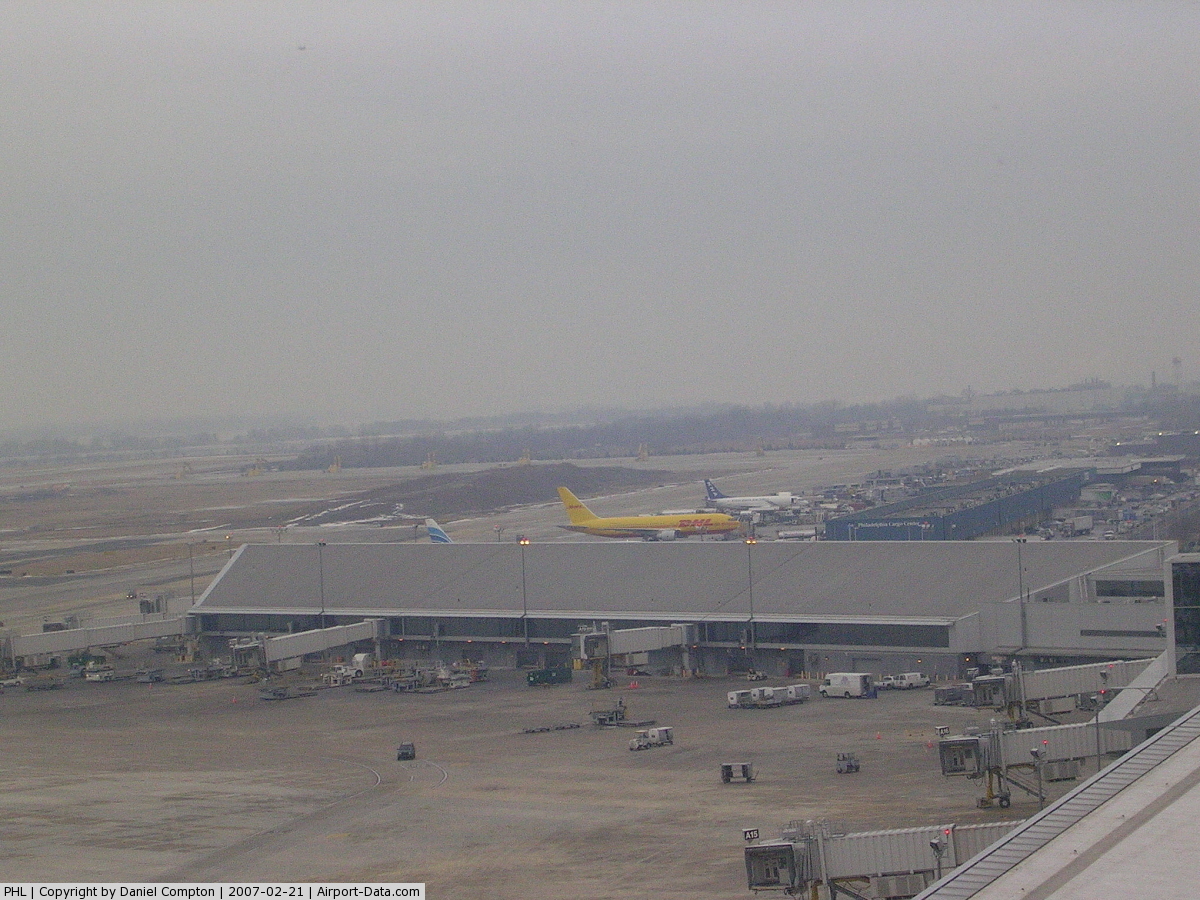
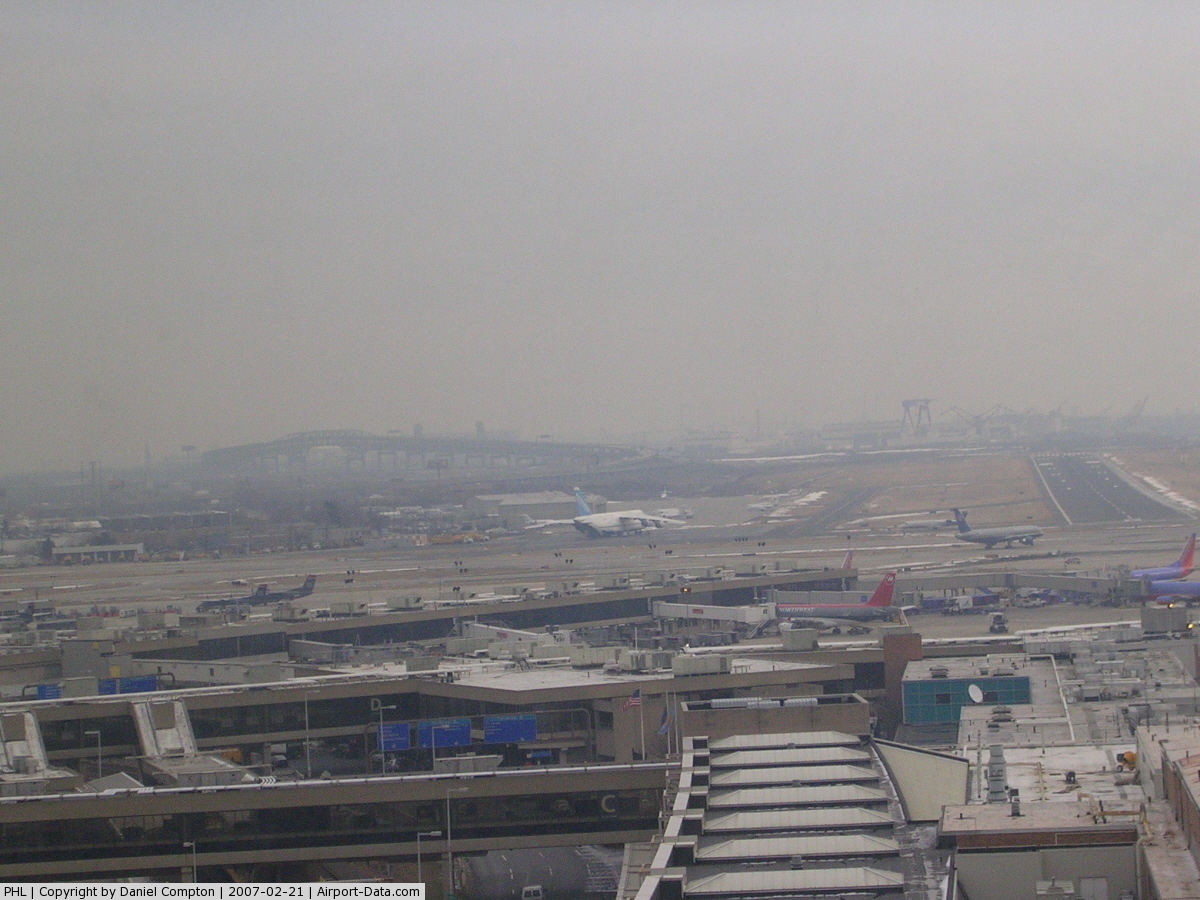
Philadelphia International Airport has seven terminal buildings, which are divided into seven lettered concourses. Terminals A East and A West, B, C, D, and E are all interconnected, and it is possible to travel through all of these without reentering security. Terminal F, completed in 2003, is completely separate from these terminals. There are, however, shuttle buses inside security between Terminal F and Terminal C using gate C16, an old US Airways Express gate and between Terminal F and Terminal A, at gate A1. There is a large shopping/dining area between Concourses B and C.
Ongoing construction at the airport will add new passenger facilities between Terminals D and E, connecting E to the rest of the Terminal complex.
Terminal A West
One of the two newest terminal buildings at the airport, Concourse A West has a very modern and innovative design. Opened in 2003 as the new international terminal, it is now home to all international flights (except Canada), and also some US Airways domestic flights. It offers a variety of international dining options.
International Arrivals (except from locations with Customs preclearance) are processed at the Terminal A West arrival building.
Terminal A-West contains 13 gates: A-14 to A-26.
Terminal A East
This terminal, originally the airport's international terminal, is now used mainly by domestic carriers, but also sometimes by US Airways for international flights. A East is well upgraded and well maintained, and recently received a new baggage claim upgrade.
Despite in Terminal A-East that some international airlines use the terminal for departing flights (e.g. Air Jamaica, certain destinations of USA3000), those airlines who transported passengers from any area requiring a passport always park their aircraft in Terminal A-West, which is the only terminal that provides US Immigration/Customs facilities & services, primarily due to gate usage efficiency. Delta relocated its ticketing operations from Terminal A-East to Terminal E on January 19. However, passenger gates and baggage claim for the combined carrier is located in Terminal D.
Terminal A-East contains 13 gates: A-1 to A-13.
Terminals B and C
Terminals B and C are the two main US Airways terminals. They are connected by a very large shopping mall and food court named the Philadelphia Marketplace. The gate areas have recently started getting remodeled, though there is a lack of space at many of the gates. Overall, the facilities are fairly modern and dining options on the concourses are also available.
Terminal B contains 16 gates: B-1 to B-16, and Terminal C contains 16 gates: C-16 to C-31.
Terminal D
Terminal D along with Terminal E were upgraded at the end of 2008 with a new concourse connecting the two terminals, providing combined ticketing for the two terminals and a variety of shops and restaurants, similar to the one between Terminals B and C, and a connector building between Baggage Claims D and E. This terminal is connected to the shopping area of Terminals B/C through a post-security walkway. AirTran Airways relocated operations from Terminal D to Terminal E. However, AirTran passengers still check-in and use the baggage claim at Terminal D.
Terminal D contains 16 gates: D-1 to D-16.
Terminal E
This terminal is also slated for renovations. Like in Terminal D, food selections are generally limited. Ticketing areas are strained for space because of Southwest's rapid growth. Also strained by Southwest's growth is the baggage claim area. It serves Southwest passengers arriving in both Terminals D and E, in a very limited space. Overall, the baggage claim area is in dismal condition, requiring very heavy operations in a very cramped area. To help reduce the congestion problems in the baggage area, Southwest now shares AirTran's baggage carousel in the Terminal D baggage claim for passengers arriving there. It also has its own baggage services office located nearby in D. AirTran Airways, which previous operated from Terminal D, moved to Terminal E. However, check-in and baggage claim for AirTran is still handled at Terminal D. On January 19, Delta relocated its ticket counters to Terminal E. However, Delta's gate operations and baggage claim are located at Terminal D.
Terminal E contains 17 gates: E-1 to E-17.
Terminal F (Concourses 1, 2, and 3)
Terminal F is a regional terminal, for US Airways Express flights. It includes special jet bridges that allow passengers to board commuter planes without walking on the tarmac. Opened in 2001, Terminal F is the second youngest terminal building at Philadelphia International.
When Terminal F opened in 2001, it was provided with 10,000 SF of concessions.
Terminal F contains 39 gates: F-1 to F-39.
Airlines and Destinations
| Airlines |
Destinations |
Terminal |
| Air Canada |
Toronto-Pearson |
D |
| AirTran Airways |
Atlanta, Orlando |
D,E |
| American Airlines |
Chicago-O'Hare, Dallas/Fort Worth, Miami, San Juan [ends April 4] |
A-East |
| American Eagle |
Chicago-O'Hare |
A-East |
| British Airways |
London-Heathrow |
A-West |
| Caribbean Airlines operated by Air Jamaica |
Montego Bay |
A-East |
| Continental Airlines |
Houston-Intercontinental |
D |
| Continental Connection operated by CommutAir |
Newark |
D |
| Continental Express operated by Chautauqua Airlines |
Cleveland |
D |
| Continental Express operated by ExpressJet Airlines |
Cleveland |
D |
| Delta Air Lines |
Atlanta, Detroit, Minneapolis/St. Paul, Paris-Charles de Gaulle, Salt Lake City |
D |
| Delta Connection operated by Chautauqua Airlines |
Cincinnati/Northern Kentucky |
D |
| Delta Connection operated by Comair |
Cincinnati/Northern Kentucky, Detroit, Memphis, New York-JFK |
D |
| Delta Connection operated by Mesaba Airlines |
Detroit, Minneapolis/St.Paul |
D |
| Delta Connection operated by Pinnacle Airlines |
Memphis |
D |
| Frontier Airlines |
Denver |
A-East |
| Frontier Airlines operated by Chautauqua Airlines |
Milwaukee [ends November 17] |
A-East |
| Frontier Airlines operated by Republic Airlines |
Milwaukee |
A-East |
| Lufthansa |
Frankfurt |
A-West |
| Southwest Airlines |
Boston, Chicago-Midway, Denver, Fort Lauderdale, Fort Myers, Houston-Hobby, Jacksonville (FL), Las Vegas, Manchester (NH), Nashville, Orlando, Phoenix, Pittsburgh, Providence, Raleigh/Durham, St. Louis, Tampa, West Palm Beach |
E |
| United Airlines |
Chicago-O'Hare, Denver, Los Angeles, San Francisco |
D |
| United Express operated by GoJet Airlines |
Chicago-O'Hare |
D |
| United Express operated by Mesa Airlines |
Chicago-O'Hare |
D |
| United Express operated by Trans States Airlines |
Washington-Dulles |
D |
| US Airways |
Atlanta, Baltimore, Boston, Buffalo, Charlotte, Chicago-O'Hare, Dallas/Fort Worth, Denver, Detroit, Fort Lauderdale, Fort Myers, Hartford/Springfield, Indianapolis, Jacksonville, Las Vegas, Los Angeles, Manchester (NH), Miami, Minneapolis/St. Paul, New Orleans, New York-LaGuardia, Orlando, Phoenix, Pittsburgh, Providence, Raleigh/Durham, Rochester, San Diego, San Francisco, San Juan,Sarasota, Seattle/Tacoma, Syracuse, Tampa, Washington-Reagan, West Palm Beach
Seasonal: Anchorage, Portland (OR), Sacramento |
B, C |
| US Airways |
Amsterdam, Aruba, Bermuda, Brussels, Cancún, Dublin, Frankfurt, London-Heathrow, Madrid, Manchester (UK), Montego Bay, Munich, Nassau, Paris-Charles de Gaulle, Punta Cana, Rome-Fiumicino, St. Maarten, Santo Domingo, Tel Aviv, Zürich
Seasonal: Antigua, Athens, Barcelona, Freeport, Glasgow-International, Grand Cayman, Lisbon, Oslo-Gardermoen, Providenciales, St. Lucia, St. Thomas, San Jose de Costa Rica, Venice-Marco Polo |
A-West, A-East
|
| US Airways Express operated by Air Wisconsin |
Albany, Allentown/Bethlehem, Baltimore, Bangor, Binghamton (NY), Birmingham (AL), Boston, Buffalo, Burlington (VT), Charleston (SC), Charlotte, Cincinnati/Northern Kentucky, Cleveland, Columbia (SC), Columbus (OH), Dayton, Detroit, Elmira/Corning, Greensboro, Greenville/Spartanburg (SC), Halifax, Hartford/Springfield, Ithaca, Kansas City, Long Island/Islip, Louisville, Manchester (NH), Milwaukee, Montreal-Trudeau, Nashville, Newburgh, Newport News, New York-LaGuardia, Norfolk, Ottawa, Pittsburgh, Portland (ME), Providence, Raleigh/Durham, Richmond, Roanoke, Rochester (NY), St. Louis, Savannah, State College, Syracuse, Toronto-Pearson, Washington-Reagan, White Plains, Wilkes-Barre/ Scranton, Wilmington (NC)
Seasonal: Myrtle Beach |
F
|
| US Airways Express operated by Chautauqua Airlines |
Baltimore, Cleveland, Columbus (OH), Louisville, New York-LaGuardia, Providence, Richmond, Washington-Reagan, Wilmington (NC) |
F
|
| US Airways Express operated by Piedmont Airlines |
Albany, Allentown/Bethlehem, Baltimore, Bangor, Binghamton (NY), Buffalo, Burlington (VT), Charlottesville, Elmira/Corning, Erie, Harrisburg, Ithaca, Long Island/Islip, Manchester (NH), Newark, Newburgh, New Haven, Newport News, New York-LaGuardia, Norfolk, Providence, Richmond, Roanoke, Rochester (NY), Salisbury, State College, Syracuse, Washington-Reagan, White Plains, Wilkes-Barre/Scranton, Williamsport |
F
|
| US Airways Express operated by PSA Airlines |
Akron/Canton, Albany, Baltimore, Charlotte, Dayton, Knoxville, New York-LaGuardia, Richmond, Washington-Reagan, Wilkes-Barre/Scranton |
F
|
| US Airways Express operated by Republic Airlines |
Albany, Atlanta, Baltimore, Boston, Buffalo, Burlington (VT), Charleston (SC), Charlotte, Cleveland, Columbus (OH), Dallas/Fort Worth, Detroit, Greensboro, Hartford/Springfield, Houston-Intercontinental, Indianapolis, Kansas City, Manchester (NH), Minneapolis/St. Paul, Myrtle Beach, Montreal-Trudeau, Nashville, New Orleans, Norfolk, Ottawa, Pittsburgh, Portland (ME), Providence, Raleigh/Durham, Richmond, Rochester (NY), St. Louis, Savannah, Syracuse, Toronto-Pearson, Washington-Reagan, Wilmington (NC) |
B,C
|
| USA 3000 Airlines |
Cancun, Punta Cana
Seasonal: Bermuda |
A-East |
Incidents
- On Wednesday, February 7, 2006, a UPS cargo plane suffered an in-flight cargo fire and made an emergency landing at Philadelphia International Airport after filling with smoke. There were no injuries other than smoke inhalation affecting the crew, but the plane burned on the ground for hours into the night, though most of the cargo survived, and the fuselage was a total loss, with multiple holes burned through the roof skin. According to the NTSB , the firefighting crew did not have adequate training on using their skin-piercing extinguishing equipment and, not knowing how to open the main cargo door, attempted to force the handle and broke the latch, rendering the door unopenable. There were also difficulties in obtaining the cargo manifest to determine what if any hazardous materials were on board, due to confusion about protocol. However, despite these failings, the airport staff, including the firefighting staff, managed the incident successfully without injury or major disruption of the airport. The NTSB suspected lithium ion batteries were the source of ignition and made recommendations for more stringent rules and restrictions on their air transport, especially on passenger aircraft (unlike this one). For a cause of the incident, the NTSB focused on the delayed indication of fire by the required onboard fire detection system and criticized the standards to which such systems are tested, noting that the tests use an empty cargo hold and do not represent the real-world performance of the detection systems with the hold full of cargo, which significantly changes the flow patterns of hot air and smoke. The crew and air traffic control personnel were found to have behaved properly (with minor exceptions) and not to be at fault for the incident or its outcome.
- On Sunday, November 16, 2008, Flight 4551, a US Airways Express deHavilland Dash-8 turboprop operated by Piedmont Airlines, took off from Lehigh Valley International Airport at 8:20am heading to Philadelphia International Airport, had to make an emergency landing. The flight crew indicated that the front nose gear hadn't come down and had to make a flyover the runway for confirmation. Of 35 passengers and 3 crew, there were no injuries.
- On Saturday November 7, 2009, an engine caught fire on a Delta MD-88 (flight 1016) originating from Hartsfield-Jackson Atlanta International Airport going to Philadelphia International Airport. All 138 passengers were evacuated without injury.
The above content comes from Wikipedia and is published under free licenses – click here to read more.

 |
(Click on the photo to enlarge) |
 |
(Click on the photo to enlarge) |
 |
(Click on the photo to enlarge) |
 |
(Click on the photo to enlarge) |
 |
(Click on the photo to enlarge) |
 |
(Click on the photo to enlarge) |
 |
(Click on the photo to enlarge) |
 |
(Click on the photo to enlarge) |
 |
(Click on the photo to enlarge) |
Location & QuickFacts
| FAA Information Effective: | 2008-09-25 |
| Airport Identifier: | PHL |
| Airport Status: | Operational |
| Longitude/Latitude: | 075-14-28.1000W/39-52-19.0000N -75.241139/39.871944 (Estimated) |
| Elevation: | 36 ft / 10.97 m (Surveyed) |
| Land: | 2302 acres |
| From nearest city: | 5 nautical miles SW of Philadelphia, PA |
| Location: | Philadelphia County, PA |
| Magnetic Variation: | 10W (1980) |
Owner & Manager
| Ownership: | Publicly owned |
| Owner: | City Of Philadelphia |
| Address: | Div Of Aviation Terminal E Philadelphia, PA 19153 |
| Phone number: | 215-937-6800 |
| Manager: | Charles J. Isdell |
| Address: | Div Of Aviation Terminal E Philadelphia, PA 19153 |
| Phone number: | 215-937-6914 OR 6800. |
Airport Operations and Facilities
| Airport Use: | Open to public |
| Wind indicator: | Yes |
| Segmented Circle: | No |
| Control Tower: | Yes |
| Lighting Schedule: | DUSK-DAWN |
| Beacon Color: | Clear-Green (lighted land airport) |
| Landing fee charge: | Yes |
| Sectional chart: | Washington |
| Region: | AEA - Eastern |
| Boundary ARTCC: | ZDC - Washington |
| Responsible ARTCC: | ZNY - New York |
| Tie-in FSS: | IPT - Williamsport |
| FSS on Airport: | No |
| FSS Toll Free: | 1-800-WX-BRIEF |
| NOTAMs Facility: | PHL (NOTAM-d service avaliable) |
| Certification type/date: | I E S 05/1973 |
| Federal Agreements: | NGYH |
Airport Communications
Airport Services
| Fuel available: | 100LLA |
| Airframe Repair: | MAJOR |
| Power Plant Repair: | MAJOR |
| Bottled Oxygen: | HIGH/LOW |
| Bulk Oxygen: | HIGH/LOW |
Runway Information
Runway 08/26
| Dimension: | 5000 x 150 ft / 1524.0 x 45.7 m |
| Surface: | ASPH, Good Condition |
| Surface Treatment: | Saw-cut or plastic Grooved |
| Weight Limit: | Dual tandem wheel: 60000 lbs. |
| Edge Lights: | High |
| |
Runway 08 |
Runway 26 |
| Longitude: | 075-13-48.0433W | 075-12-45.9439W |
| Latitude: | 39-52-42.0165N | 39-52-54.3831N |
| Elevation: | 9.00 ft | 36.00 ft |
| Alignment: | 75 | 127 |
| ILS Type: | | ILS/DME
|
| Traffic Pattern: | Left | Left |
| Markings: | Basic, Good Condition | Precision instrument, Good Condition |
| Crossing Height: | 0.00 ft | 50.00 ft |
| VASI: | | 4-light PAPI on right side |
| Visual Glide Angle: | 0.00° | 3.15° |
| RVR Equipment: | touchdown, rollout | touchdown, rollout |
| Approach lights: | | MALSR |
| Centerline Lights: | Yes | Yes |
| Obstruction: | 190 ft bldg, 4520.0 ft from runway, 200 ft left of centerline, 22:1 slope to clear | 5 ft fence, 220.0 ft from runway, 280 ft right of centerline, 4:1 slope to clear +5' FENCE 160' FROM AER, 240' LEFT. |
|
Runway 09L/27R
| Dimension: | 9500 x 150 ft / 2895.6 x 45.7 m |
| Surface: | ASPH, Good Condition |
| Surface Treatment: | Saw-cut or plastic Grooved |
| Weight Limit: | Single wheel: 100000 lbs. Dual wheel: 210000 lbs. Dual tandem wheel: 350000 lbs. |
| Edge Lights: | High |
| |
Runway 09L |
Runway 27R |
| Longitude: | 075-15-20.3907W | 075-13-22.4377W |
| Latitude: | 39-52-07.2558N | 39-52-30.7913N |
| Elevation: | 13.00 ft | 11.00 ft |
| Alignment: | 75 | 127 |
| ILS Type: | ILS/DME
| ILS/DME
|
| Traffic Pattern: | Left | Left |
| Markings: | Precision instrument, Good Condition | Precision instrument, Good Condition |
| Crossing Height: | 71.00 ft | 81.00 ft |
| VASI: | 4-light PAPI on left side | 4-light PAPI on left side |
| Visual Glide Angle: | 3.00° | 3.00° |
| RVR Equipment: | touchdown | touchdown |
| Approach lights: | MALSR | MALSR |
| Runway End Identifier: | Yes | |
| Centerline Lights: | Yes | Yes |
| Touchdown Lights: | No | No |
| Obstruction: | 17 ft gnd, 1020.0 ft from runway, 460 ft left of centerline, 48:1 slope to clear | 189 ft boat, 4500.0 ft from runway, 23:1 slope to clear |
|
Runway 09R/27L
| Dimension: | 10506 x 200 ft / 3202.2 x 61.0 m |
| Surface: | ASPH, Good Condition |
| Surface Treatment: | Saw-cut or plastic Grooved |
| Weight Limit: | Single wheel: 200000 lbs. Dual wheel: 210000 lbs. Dual tandem wheel: 350000 lbs. |
| Edge Lights: | High |
| |
Runway 09R |
Runway 27L |
| Longitude: | 075-16-30.6995W | 075-14-20.2695W |
| Latitude: | 39-51-38.9176N | 39-52-04.9521N |
| Elevation: | 20.00 ft | 9.00 ft |
| Alignment: | 75 | 127 |
| ILS Type: | ILS/DME
| ILS/DME
|
| Traffic Pattern: | Left | Left |
| Markings: | Precision instrument, Good Condition | Precision instrument, Good Condition |
| Crossing Height: | 0.00 ft | 71.00 ft |
| VASI: | | 4-light PAPI on right side |
| Visual Glide Angle: | 0.00° | 3.10° |
| RVR Equipment: | rollout | touchdown, midfield, rollout |
| Approach lights: | ALSF2 | MALSR |
| Centerline Lights: | Yes | Yes |
| Touchdown Lights: | Yes | No |
| Obstruction: | 11 ft trees, 400.0 ft from runway, 360 ft left of centerline, 18:1 slope to clear | 189 ft boat, 4500.0 ft from runway, 23:1 slope to clear |
|
Runway 17/35
| Dimension: | 5460 x 150 ft / 1664.2 x 45.7 m |
| Surface: | ASPH, Good Condition |
| Surface Treatment: | Saw-cut or plastic Grooved |
| Weight Limit: | Single wheel: 100000 lbs. Dual wheel: 170000 lbs. Dual tandem wheel: 300000 lbs. |
| Edge Lights: | High |
| |
Runway 17 |
Runway 35 |
| Longitude: | 075-14-07.0062W | 075-13-41.9803W |
| Latitude: | 39-53-09.6919N | 39-52-19.2953N |
| Elevation: | 9.00 ft | 9.00 ft |
| Alignment: | 127 | 127 |
| ILS Type: | ILS
| |
| Traffic Pattern: | Left | Left |
| Markings: | Precision instrument, Good Condition | Precision instrument, Good Condition |
| Crossing Height: | 50.00 ft | 0.00 ft |
| VASI: | 4-light PAPI on left side PAPI UNUSBL BYD 6 DEGS EITHER SIDE OF CNTRLN. | |
| Visual Glide Angle: | 3.00° | 0.00° |
| RVR Equipment: | touchdown | touchdown |
| Approach lights: | MALSR | |
| Runway End Identifier: | | No |
| Obstruction: | 50 ft pole, 1220.0 ft from runway, 560 ft right of centerline, 20:1 slope to clear | 189 ft boat, 2550.0 ft from runway, 12:1 slope to clear |
|
Radio Navigation Aids
| ID |
Type |
Name |
Ch |
Freq |
Var |
Dist |
| ING | NDB | Ambler | | 275.00 | 11W | 15.4 nm |
| NXX | NDB | Willow Grove | | 388.00 | 12W | 19.6 nm |
| RNB | NDB | Rainbow | | 363.00 | 11W | 27.7 nm |
| DYL | NDB | Doylestown | | 237.00 | 10W | 28.4 nm |
| UKT | NDB | Quakertown | | 208.00 | 12W | 33.3 nm |
| NEL | NDB | Lakehurst | | 396.00 | 13W | 43.0 nm |
| APG | NDB | Aberdeen | | 349.00 | 11W | 44.8 nm |
| NXX | TACAN | Willow Grove | 061X | | 10W | 19.9 nm |
| NEL | TACAN | Lakehurst | 055X | | 11W | 42.1 nm |
| DOV | TACAN | Dover | 037X | | 09W | 45.7 nm |
| NEL | UHF/NDB | Lakehurst | | 274.80 | 13W | 43.0 nm |
| PNE | VOR | North Philadelphia | | 112.00 | 10W | 16.5 nm |
| ARD | VOR/DME | Yardley | 019X | 108.20 | 10W | 27.6 nm |
| CKZ | VOR/DME | Pennridge | 025Y | 108.85 | 12W | 31.3 nm |
| ETX | VOR/DME | East Texas | 039X | 110.20 | 09W | 47.2 nm |
| SBJ | VOR/DME | Solberg | 076X | 112.90 | 10W | 48.5 nm |
| PPM | VOR/DME | Phillips | 021X | 108.40 | 09W | 49.4 nm |
| OOD | VORTAC | Woodstown | 075X | 112.80 | 10W | 14.5 nm |
| MXE | VORTAC | Modena | 079X | 113.20 | 09W | 20.0 nm |
| DQO | VORTAC | Dupont | 087X | 114.00 | 10W | 20.5 nm |
| VCN | VORTAC | Cedar Lake | 099X | 115.20 | 10W | 23.8 nm |
| PTW | VORTAC | Pottstown | 112X | 116.50 | 09W | 25.7 nm |
| GXU | VORTAC | Mc Guire | 043X | 110.60 | 11W | 30.8 nm |
| CYN | VORTAC | Coyle | 081X | 113.40 | 10W | 37.5 nm |
| ACY | VORTAC | Atlantic City | 023X | 108.60 | 10W | 39.6 nm |
| RBV | VORTAC | Robbinsville | 085X | 113.80 | 10W | 39.7 nm |
| ENO | VORTAC | Smyrna | 051X | 111.40 | 09W | 40.5 nm |
| PHL | VOT | Philadelphia Intl | | 109.80 | | 0.2 nm |
Remarks
- BIRDS ON & INVOF ARPT.
- TWY J BTN TWYS K3 AND Q RESTRICTED TO ACFT WITH WINGSPANS 171 FT AND LESS.
- ONLY NOSE-IN PARKING PERMITTED ON NORTH & EAST OF REMOTE APRONS. PPR FM ARPT OPNS FOR ALL ACFT PARKING ON NORTH & EAST REMOTE APRONS; CTC 215-937-6914/6800.
- POSSIBLE UNMARKED SHIP OBSTRUCTION TRANSITING EAST OR WESTBOUND ALONG THE DELAWARE RIVER REACHING HEIGHTS OF 189' - BE ALERT WHEN APPROACHING PHL RUNWAY 35 AND WHENEVER CIRCLING OR VISUALLY APPROACHING ALL OTHER RUNWAYS.
- ROUGH, UNEVEN PAVEMENT ON TWY "S" BTN TWY "L" & "S3".
- RYS 27L, 27R & 35 SHIP CHNL (DELAWARE RIVER) MAX HEIGHT OF SHIPS 189 FT. RY 26 SHIP CHNL (SCHUYLKILL) MAX HEIGHT OF SHIPS 149 FT.
- ARPT IS LCTD IN A NOISE SENSITIVE AREA. AIRPORT NOISE ABATEMENT TAKEOFF PROCEDURES ARE TO BE USED.
- TCAS EQUIPPED ACFT-TCAS ALERT MAY BE CAUSED BY TRANSPONDER EQUIPPED SHIPS LCTD PHL NAVAL BASE 3 NM E.
- UNLGTD STACK 288 FT MSL (271 FT AGL) 2.3 NM SW OF ARPT.
- RY 09R ROLLOUT RVR USED FOR RY 09L MIDPOINT RVR.
- ALL ENGINE RUNUPS REQUIRE PPR FM DUTY OPNS OFFICER AT 937-6914/6800; RUNUPS 20 MIN MAXIMUM.
- ALL ACFT TRAVELING ON TWY J MUST USE MINIMUM POWER WHEN TURNING SOUTH DUE TO JETBLAST CONCERNS.
Images and information placed above are from
http://www.airport-data.com/airport/PHL/
We thank them for the data!
| General Info
|
| Country |
United States
|
| State |
PENNSYLVANIA
|
| FAA ID |
PHL
|
| Latitude |
39-52-19.030N
|
| Longitude |
075-14-28.107W
|
| Elevation |
38 feet
|
| Near City |
PHILADELPHIA
|
Thanks to: www.worldaerodata.com
We don't guarantee the information is fresh and accurate. The data may
be wrong or outdated.
For more up-to-date information please refer to other sources.
|
 |