|
|
Hamilton International Airport |
John C. Munro Hamilton International Airport (IATA: YHM, ICAO: CYHM) is an international airport located in Hamilton, Ontario, Canada. The airport is situated in Mount Hope, 6 nautical miles (11 km; 6.9 mi) southwest of Downtown Hamilton and 64 km (40 mi) southwest of Toronto. The airport serves the city of Hamilton and the adjacent Greater Toronto Area, acting as a reliever for Toronto Pearson International Airport. The now-defunct British airline Flyglobespan once referred to the airport as Toronto Hamilton International Airport.
The airport opened in 1940 as Mount Hope Airport, which was primarily a Royal Canadian Air Force base. The end of World War II saw the closure of the base, and its conversion to civil use attracted regional and international passenger services with connections to major Canadian cities and seasonal destinations. Regular services to the U.S. ceased as nearby Buffalo Niagara International Airport gained popularity for cross-border travellers in the region, but Hamilton remained an important base for a number of domestic and transatlantic low-cost carriers.
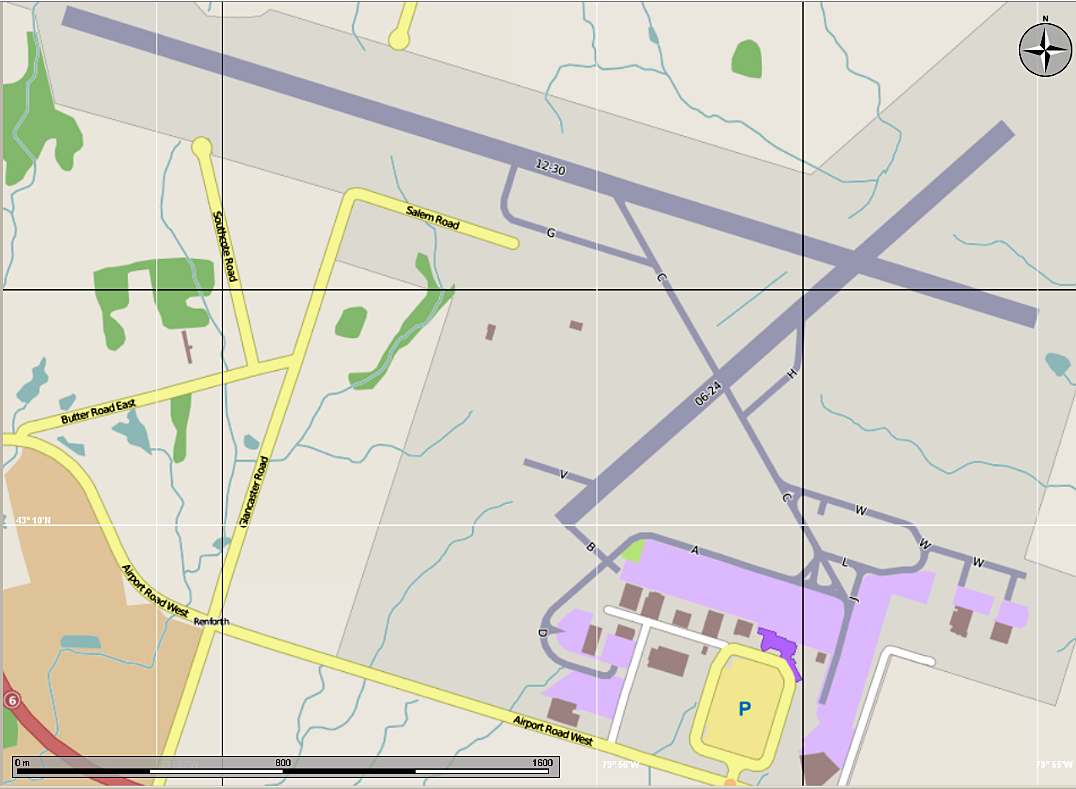
Hamilton is designed for use by large airplanes on overseas flights, and includes a 10,006 ft × 200 ft (3,050 m × 61 m) asphalt runway with centreline lighting for low-visibility operations, and a smaller 6,010 ft × 150 ft (1,832 m × 46 m) asphalt runway. It is classified as an airport of entry by Nav Canada and is staffed by the Canada Border Services Agency (CBSA). As Canada’s «largest overnight express cargo airport,» Hamilton handles large cargo operations with aircraft such as the Boeing 747 or Antonov An-124. The Canadian Warplane Heritage Museum is located adjacent to the airport.
|
John C. Munro Hamilton International Airport
|
|
|
- IATA: YHM
- ICAO: CYHM
- WMO: 71263
|
| Summary |
| Airport type |
Public |
| Owner |
City of Hamilton |
| Operator |
TradePort International Corporation |
| Serves |
Hamilton, Ontario |
| Hub for |
- Cargojet
- SkyLink Express
- Purolator
- Canada Jetlines
- Swoop
|
| Time zone |
EST (UTC−05:00) |
| • Summer (DST) |
EDT (UTC−04:00) |
| Elevation AMSL |
780 ft / 238 m |
| Coordinates |
43°10′25″N
079°56′06″W |
| Website |
www.flyhamilton.ca |
| Map |
|
|
| Runways |
| Direction |
Length |
Surface |
| ft |
m |
| 06/24 |
6,010 |
1,832 |
Asphalt |
| 12/30 |
10,006 |
3,050 |
Asphalt |
|
| Statistics (2017) |
| Aircraft movements |
36,808 |
| Number of Passengers |
599,146 |
|
History
Early history
Hamilton’s first airport was the Hamilton Municipal Airport at Reid Avenue North and Dunsmure Road (site of Roxborough Park) in 1929. It began as the home to the Hamilton Aeroclub. The Royal Canadian Air Force (RCAF) became a major user of the airport in the 1930s, but the airport closed in the 1950s to make way for residential development.
In 1940, Mount Hope Airport was opened and became the site of RCAF Station Hamilton. During World War II, the field hosted two units for the British Commonwealth Air Training Plan: first, No. 10 Elementary Flying Training School (later moved to RCAF Station Pendleton) using the De Havilland Tiger Moth and Fleet Finch, then No. 33 Air Navigation School using the Avro Anson. After the war, the airport gradually shifted towards civil use, until the military ceased using it as a base for Air Reserve operations in 1964.
From 1969 to 1985, Nordair offered jet service from Hamilton to Montreal, Grand Bahama Island and Windsor. City Express flew to Montreal and Ottawa for three months in 1985. Tempus Air offered same route as City Express from 1986 to 1988. USAir began service to Pittsburgh in 1987. By 1988, Pan Am Express flew to New York City and Nationair flew to London, England. Pan Am Express and Nationair stopped their operations at Hamilton in the following year. Canadian Partner began service to Montreal and Ottawa in 1989.
1990s
Canadian Partner’s service to Montreal and Ottawa ended in 1991. In the same year, Pem-Air and Air Laurentianoffered service to Ottawa but both airlines stopped the route in 1993. Northwest Airlink offered flights to Detroit from 1992 to 1993. There was no scheduled passenger service until Greyhound Air flew to Hamilton in 1996 before the company folded in 1997.
In 1996, Hamilton-Wentworth signed a contract with a private company to manage and operate it for 40 years. The consortium consisted of WestPark Developments, Vancouver Airport Authority and TradePort International Corporation Ltd., a subsidiary of Vantage Airport Group, which manages 10 airports.
From 2000 to 2010
In 2000 WestJet expanded to Canada’s eastern region, choosing Hamilton as the airline’s eastern region hub, and flying to destinations from Newfoundland and Labrador to British Columbia. Continental Airlines also offered service to Cleveland in 2000 but stopped in the same year. In April 2004, seeking to compete with Air Canada for business travellers, WestJet moved its eastern hub from Hamilton to Toronto Pearson International Airport. While Hamilton retained flights to many destinations, services between Hamilton and Montrealand Ottawa were ended. In the wake of the WestJet pullout, CanJet began service to Hamilton in 2003. Then in the spring of 2005, two weeks after Air Canada Jazzannounced it would enter the local market with service from Hamilton to Montreal and Ottawa, CanJet announced a complete withdrawal from Hamilton. Citing high fuel prices, Air Canada Jazz withdrew its services from Hamilton airport to Montreal and Ottawa by 2008. From 2007 to 2009, Flyglobespan offered seasonal service to the United Kingdom, including Liverpool, Manchester and Doncaster. In 2010, WestJet cut two-thirds of its flights out of Hamilton. The only remaining service by WestJet was one daily service to Calgary. In 2015, Air Canada Rouge planned to begin daily service to Calgary by June 2015 but the launch was delayed and ultimately cancelled.
In 2007, YVR Airport Services (now Vantage Airport Group), which runs the Vancouver International Airport, took over 100 per cent ownership of TradePort International in a $13-million deal. In late 2007, Trade Port Co. and Citi Corp. bought land from the city of Hamilton to expand runway 06/24 to 9,000 ft (2,743 m). This was expected to happen sometime between 2015 and 2019.
After 2010
Hamilton saw growth as Air Canada resumed daily flights to Montreal in 2016 via Air Canada Express and WestJet adding service to Edmonton, Halifax and Winnipeg.
Since the 1970s, Greater Toronto Airports Authority (GTAA) and the Government of Canada have planned a second international airport for Toronto in the neighbouring city of Pickering, Ontario to act as a reliever for Toronto-Pearson. Supporters of the plan argued that Hamilton is too far from Toronto to be a reliever, while the opposition argued that the reliever airports for Logan International Airport in Boston (T.F. Green State Airport in Providence, Rhode Island and Manchester-Boston Regional Airport in Manchester, New Hampshire) are used effectively despite being farther from the Boston city centre than Hamilton is from Downtown Toronto. In October 2017, the Pickering City Council supported the development of an airport in Pickering during its joint-bid with the rest of Greater Toronto to host Amazon HQ2. However, a GTAA report in December 2017 suggested that an airport in Pickering was not necessary at the moment and that Pearson can meet demand until 2037.
In 2017, Hamilton experienced an 80 per cent increase in passengers, to 600,000, which was still well below its capacity of 3 million per year. It also remained Canada’s top domestic cargo airport. In 2018, ultra-low-cost carriers including Flair Airlines, Canada Jetlines and Swoop chose Hamilton as a hub for service to the Greater Toronto region. Also in 2018, Norwegian Air Shuttle announced that it would offer direct service from Hamilton to Dublin starting in spring 2019, bringing transatlantic service to the airport for the first time in over a decade. Hamilton charges 30 to 50 per cent lower fees to airlines than Pearson and its compact size makes travel quicker for passengers and allows aircraft to spend less time on the ground. Flair Airlines ended services and shifted operations to Toronto Pearson in mid-2018.
Airlines and destinations
Passenger
| Destinations |
| Air Canada Express |
Montréal–Trudeau (ends March 30, 2019) |
| Air Transat |
Seasonal: Cancún, Cayo Coco, Puerto Plata, Punta Cana, Varadero |
| Norwegian Air Shuttle |
Dublin (begins 31 March 2019) |
| Sunwing Airlines |
Seasonal: Punta Cana, Varadero |
| Swoop |
Abbotsford, Edmonton, Halifax, Winnipeg
Seasonal: Cancún, Fort Lauderdale, Las Vegas, Montego Bay Orlando, Puerto Vallarta, Tampa |
| WestJet |
Calgary
Seasonal: Vancouver |
Cargo
| Destinations |
| Cargojet Airways |
Calgary, Cincinnati, Cologne/Bonn, Edmonton, Halifax, Moncton, Montréal–Mirabel, Ottawa, St. John’s, Vancouver, Winnipeg |
|
| Castle Aviation |
Akron/Canton, Cleveland |
|
| DHL Aviation |
Cincinnati |
|
| Purolator Courier |
Akron, Cincinnati, Columbus–Rickenbacker, Montréal–Mirabel, Halifax |
|
| SkyLink Express |
Kingston, Louisville, Muskoka, New York–JFK, North Bay, Sault Ste. Marie, Sudbury, Windsor |
|
| UPS Airlines |
Louisville |
|
Statistics
Annual traffic
Annual Passenger Traffic
| Year |
Passengers |
% Change |
| 2010 |
387,831 |
- |
| 2011 |
332,659 |
-14.2% |
| 2012 |
351,491 |
5.6% |
| 2013 |
341,740 |
-2.8% |
| 2014 |
332,378 |
-2.7% |
| 2015 |
312,839 |
-5.9% |
| 2016 |
333,368 |
6.7% |
| 2017 |
599,146 |
80% |
Ground transportation
The airport is located on Highway 6, which provides access via Highway 403 to Brantford in the west, Toronto and Niagara Falls in the east, and Guelph and Kitchener-Waterloo region in the north. Private shuttle bus service is available from the airport to Toronto Pearson International Airport and Toronto Union Station. The Hamilton Street Railway (HSR) operates bus route 20 A-Line Express, a limited-stop weekday service, from the airport to Hamilton GO Centre in downtown Hamilton.
Aviation institutions
The aviation programs of Mohawk College have facilities at the airport. As of 2017 the learning facilities include an electricity lab, a hangar, airport apron and two classrooms. Golden Horseshoe Aviation (GHA) is a flight school based at the Jetport facilities.
Accidents and incidents
- A chartered Boeing 707 carrying rock band Bon Jovi skidded off the runway in January 2006.
The above content comes from Wikipedia and is published under free licenses – click here to read more.
| General
Info |
| Country |
Canada
|
| ICAO ID |
CYHM
|
| Time |
UTC-5(-4DT)
|
| Latitude |
43.173611
43° 10' 25.00" N |
| Longitude |
-79.935000
079° 56' 06.00" W |
| Elevation |
780 feet
238 meters |
| Type |
Civil
|
| Magnetic
Variation |
010° W
(01/06) |
| Beacon |
Yes
|
| Operating
Agency |
CIVIL
GOVERNMENT, (LANDING FEES AND DIPLOMATIC CLEARANCE MAY BE REQUIRED)
|
| Operating
Hours |
24 HOUR
OPERATIONS |
| International
Clearance Status |
Airport
of Entry |
| Daylight
Saving Time |
Second
Sunday in March at 0200 to first Sunday in November at 0200 local
time (Exception Arizona and that portion of Indiana in the Eastern
Time Zone) |
| Communications
|
| TWR |
119.7
125.0
308.475 |
| GND |
121.6
398.125 |
| ATIS |
128.1
|
| TORONTO
TRML |
128.27
268.75 |
| Communications
Remarks |
|
| A/D |
(APP/DEP
svc) |
| TWR |
Emerg
only C905-678-3220. |
| Runways
|
| ID |
Dimensions |
Surface |
PCN |
ILS
|
| 06/24
|
6000 x
150 feet
1829 x 46 meters |
ASPHALT |
038FDWT |
NO
|
| 12/30
|
10000
x 200 feet
3048 x 61 meters |
ASPHALT |
070FCWT |
NO
|
| Navaids
|
| Type |
ID |
Name |
Channel |
Freq |
Distance
From Field |
Bearing
From Navaid |
| NDB |
ZHM |
BINBROOK |
- |
266 |
6.4 NM |
295.9
|
| Supplies/Equipment
|
| Fuel |
Jet A1,
without icing nhibitor.
100/130 octane gasoline, leaded, MIL-L-5572F (GREEN) |
| Other
Fluids |
DE-ICE,
Anti-icing/De-icing/Defrosting Fluid (MIL A 8243)
LPHOX, Low pressure oxygen servicing |
| JASU |
CE13
AC 115/200v, 60kva, 400 hz, 3 phase
CE15
DC 22-35v, 500 amp continuous 1100 amp intermittent |
| Remarks
|
| FLUID |
De-ice
LPOX |
| FUEL |
A1 (Imperial
Oil C905-679-3558.) (NC-100) |
| JASU |
1(CE13)
1(CE15) 1(CA1) |
| LGT |
PAPI Rwy
06-24, VASI Rwy 12-30 for acft with eye-to-wheel hgt up to 25'.
|
| MISC |
Ldg fee.
Twy D, J and W unctl. |
| NS ABTMT |
Pro in
eff 0400-1100Z++. |
The content above was published at Airports-Worldwide.com in 2018.
We don't guarantee the information is fresh and accurate. The data may be wrong or outdated.
For more up-to-date information please refer to other sources.
|
|